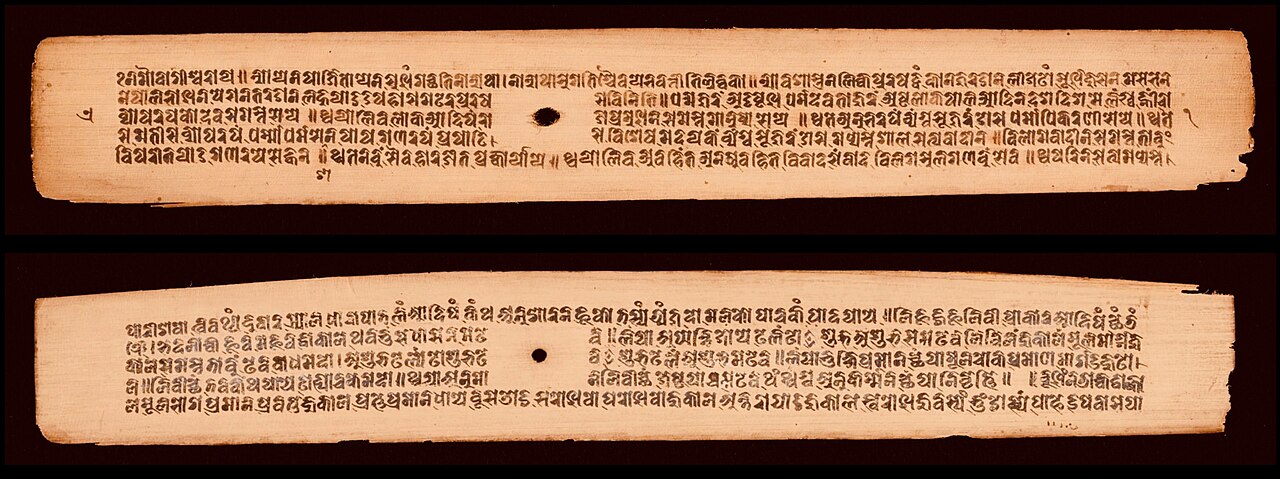
Naming was never neutral in the classical order. The Manusmṛti sets out, in two short verses, how a name should be built — and it grades the instruction by varna. This is one place the old code is unusually blunt, and because Bühler’s 1886 translation is public domain, we can quote it directly rather than paraphrase.
What Manu actually says
2.31. Let (the first part of) a Brāhmaṇa’s name (denote something) auspicious, a Kshatriya’s be connected with power, and a Vaiśya’s with wealth, but a Śūdra’s (express something) contemptible.
2.32. (The second part of) a Brāhmaṇa’s (name) shall be (a word) implying happiness, of a Kshatriya’s (a word) implying protection, of a Vaiśya’s (a term) expressive of thriving, and of a Śūdra’s (an expression) denoting service.
[Documented] — The Laws of Manu, tr. Bühler (1886), verified against the scan. The ladder is explicit: auspicious at the top, then power, then wealth, and at the bottom something contemptible, an expression denoting service. A name was meant to announce a person’s rank before they said a word.
The traditional suffix scheme
Later commentaries and usage attach the second element of the name to recognisable suffixes: -śarman / Sharma for a Brahmin, -varman / Varma for a Kshatriya, -gupta / Gupta for a Vaiśya, and -dāsa / Das for a Śūdra.
[Tradition] This mapping is real as a prescription and is echoed in the commentarial tradition — but treat it as tradition, not as a law of history. It tells you what the texts recommended, not how every actual name came to be.
Where the popular version overreaches
Two claims get built on top of these verses, and both go further than the evidence allows.
“Gupta means Brahmin.” [Documented] It does not. “Gupta” is the Vaiśya (merchant) title in exactly the scheme above, and the name of the imperial Gupta dynasty. If anything the verse points the opposite way from the myth.
“Modern surnames were generated straight from Manu.” [Debated] This inverts cause and effect. Real surname formation was multi-causal — region, occupation, gotra, sect, and a great deal of hardening under colonial-era record-keeping. Even “Gupta” is an unreliable varna signal: it appears in the names of non-Vaiśyas before and during the Gupta period, and the dynasty’s own records never state its varna — historians (Altekar, R. S. Sharma) treat the Vaiśya inference as contested, not settled. A prescriptive verse is not a birth certificate for every name that rhymes with it.
Why this sits under the wizard
This is the scholarly floor beneath the tool on the home page. The Manusmṛti wanted names to encode rank — that is documented, and damning enough on its own. But it does not follow that a surname today reliably reveals caste, and it certainly does not follow that “Gupta” is Brahmin. That gap is exactly why the wizard refuses to map a surname to a caste, and shows the surname caveat at every step. The old code aspired to make names a ladder; it does not get to make them a verdict.