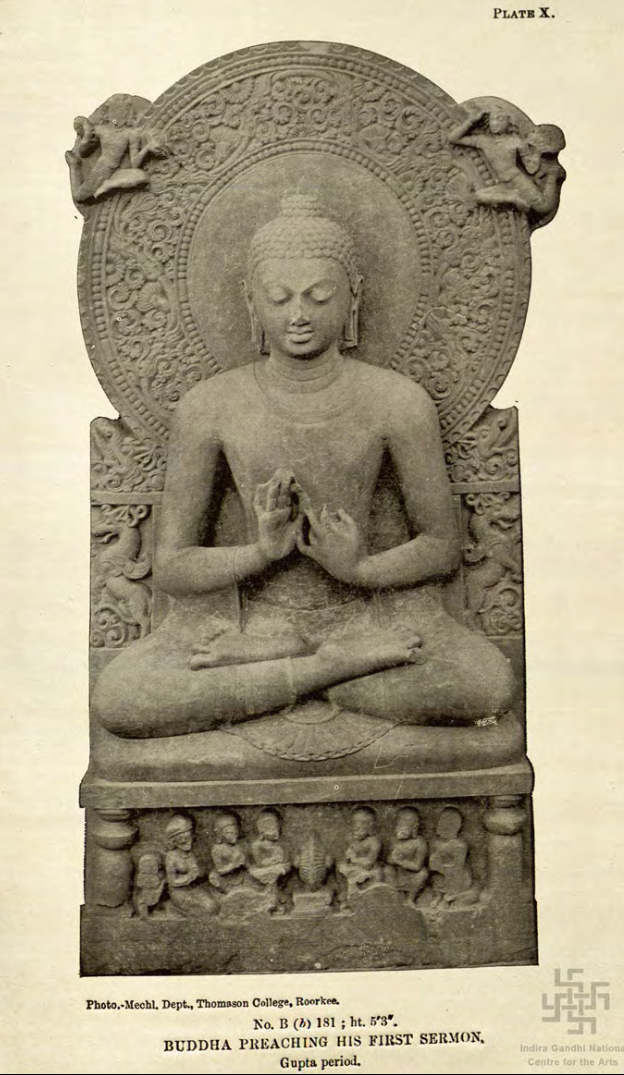
It is easy to read this site and conclude that the challenge to caste is a modern, Ambedkarite, or even Western import. That would be false, and antiquity itself refutes it. Around the sixth and fifth centuries BCE, in the cities of the Gangetic plain, India produced a homegrown revolt against birth-rank — and its texts survive.
The renouncers
Alongside the Brahmanical orthodoxy grew a cluster of heterodox śramaṇa (“renouncer”) movements: Buddhism (the Buddha), Jainism (Mahāvīra), the Ājīvikas (Makkhali Gosāla), and others. Historians treat this as one of the great intellectual ferments of the ancient world — and it was, in part, a social argument. [Documented]
The śramaṇa traditions rejected the things the old code rested on:
- the authority of the Vedas;
- the efficacy of Vedic sacrifice and the priesthood that monopolised it;
- and, pointedly, birth-based varna hierarchy as the measure of a person.
Both the Buddha and Mahāvīra came from Kshatriya, not Brahmin, backgrounds, and their movements drew strength from the rising urban and mercantile classes and from kings — a challenge to Brahmin primacy mounted from the second estate and the market, not from below alone.
Conduct, not birth
The Buddhist critique of caste is explicit in the canon, not a modern projection onto it. In the Vasala Sutta (Discourse on Outcasts), the Buddha states it in a single line — quoted here from Fausböll’s public-domain 1881 translation:
Not by birth does one become an outcast, not by birth does one become a Brāhmaṇa; by deeds one becomes an outcast, by deeds one becomes a Brāhmaṇa.
[Documented] He makes the same argument at length in the Assalāyana and Vāseṭṭha suttas: it is action and conduct — not the womb one is born from — that make a person high or low, and a person of any varna who does wrong falls, while any who does right rises.
And the saṅgha, the monastic order, enacted the point: it admitted members regardless of caste, and seniority within it ran by date of ordination, not birth — so that, in the tradition’s own famous illustration, a barber ordained before a prince outranked him in the order. Inside the community, the ladder was pulled up.
The honest limits
This is where a triumphant reading has to stop, because the śramaṇa revolt did not abolish caste, and pretending it did would be its own myth.
[Debated] The critique operated most fully within the renouncer communities; in the wider society, caste persisted through the whole Buddhist period and beyond — Al-Biruni, centuries later, still found it fully intact. Over time Buddhism and Jainism themselves accommodated social hierarchy in various ways, and Buddhism eventually declined in the land of its birth (for reasons historians still debate — royal patronage shifting, Brahmanical revival, the destruction of the monastic universities). The śramaṇas landed a permanent argument, not a permanent revolution.
Why it closes a loop
Keep the two ends of this thread in view. At one end, around 500 BCE, an Indian tradition says out loud that no one is high or low by birth. At the other end, in 1956, B. R. Ambedkar — having concluded that the untouchables’ only real exit lay outside the caste-Hindu fold but inside an Indian tradition — leads hundreds of thousands into Buddhism, and writes The Buddha and His Dhamma to recast it as a this-worldly ethic of liberty, equality and fraternity. His “Broken Men” thesis had already argued that the untouchables were, in origin, Buddhists degraded for clinging to their faith.
[Documented] So Ambedkar’s conversion was not a flight from India; it was a return to the oldest indigenous answer to caste. The śramaṇa revolt is the reason this site can say, with the record behind it, that the case against caste is not foreign and not new. India argued it with itself two and a half thousand years ago — and the man who drafted the Constitution went back and picked the argument up.